

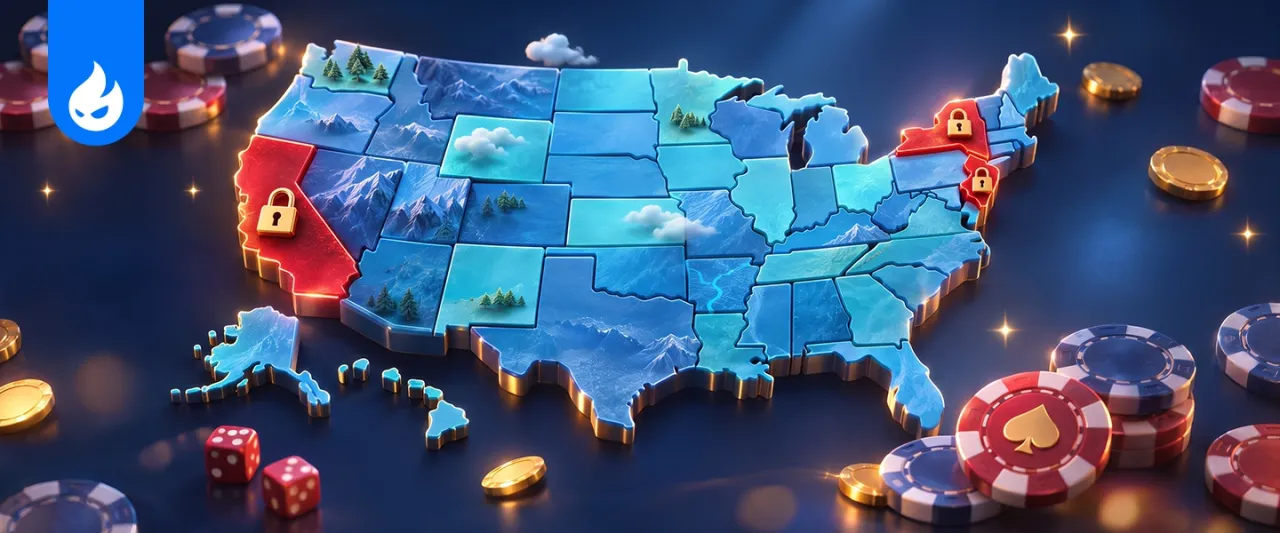
Sweepstakes casinos are banned by statute in ten US states: California, Connecticut, Indiana, Louisiana, Maine, Montana, New Jersey, New York, Tennessee and Oklahoma. Oklahoma is the newest, and its ban began on 1 November 2026. Everywhere else the picture is looser, but it keeps shifting, so a site that accepted players last spring may have closed a state by now.
This guide is mainly for readers who follow the US market, or who live there and want to understand why some sites suddenly stop taking players. If you play from outside the United States, these rules do not apply to you directly, but they explain a lot about how this business model works and why it is under pressure.
How dual-currency sweepstakes casinos work
A sweepstakes casino is not a licensed real-money casino. It runs on two virtual currencies, and that split is what the legal fights are about.
- Gold Coins are the play-money currency. They are usually bought in packs or handed out as free bonuses, and they cannot be turned into cash prizes.
- Sweeps Coins are the prize currency. Operators say they are given away free, for example in a welcome bonus, a daily login or a mail-in request, and that a purchase is not required to get them. Sweeps Coins can be redeemed for prizes once you meet the site's conditions.
Many sites hand out Sweeps Coins as a free extra when you buy Gold Coins. Critics say that makes the "free" label a fiction, since the purchase is what drives the whole experience. Operators answer that the free route exists and is legitimate. Minimum redemption amounts, verification steps and processing times all depend on the casino.
The games themselves look like ordinary online slots and table games. That resemblance is exactly why regulators treat the model as unlicensed gambling in their states, and why lawmakers have started writing bans that name the dual-currency structure directly.
Where sweepstakes casinos are banned by law
The list below follows the ten states named by WSN in its 2026 state guide. Other trackers were used to cross-check the details, and the states with a clear law and date are in the table. Dates come from those published guides, so confirm them with the official bill text before relying on them for anything important.
| State | Law | In force since |
|---|---|---|
| California | AB 831 | January 1, 2026 |
| Indiana | HB 1052 | July 1, 2026 |
| Louisiana | HB 883 and HB 53 | August 1, 2026 |
| Maine | LD 2007 | July 2026 |
| New York | S5935-A (Chapter 605 of 2025) | December 5, 2025 |
| Oklahoma | SB 1589 | November 1, 2026 |
Four more states are on the statutory ban list. Connecticut is listed with SB 1235 by one tracker, while Montana, New Jersey and Tennessee also appear as banned in the WSN guide. I did not find a law number and start date for each of them that I could confirm, so I leave those out rather than guess. For these states, the legislature's website is the place to read the actual text.
California and New York
California's governor signed an anti-sweepstakes bill in September 2025, and it took effect in January 2026. New York moved earlier: the governor signed S5935-A in December 2025 and it applied immediately. Both states were large markets, which is why these two bans changed so much for operators.
Indiana, Louisiana and Maine
All three bans arrived in summer 2026. Indiana's came first, on 1 July. Maine followed in July, although trackers disagree on the exact day, so I give only the month. Louisiana's rules came into force on 1 August. In these states, major brands have mostly switched off Sweeps Coins play, and some keep Gold Coins-only accounts instead.
Oklahoma
Oklahoma's case is the most dramatic. Governor Kevin Stitt vetoed SB 1589 on 7 May 2026 and called it "vague and overbroad", but the legislature overrode him within days. According to reporting that cites Legal Sports Report, the Senate vote was 34 to 10 and the House vote was 68 to 19.
The law targets the dual-currency model and makes it a felony to operate one. Penalties reach operators, promoters and service providers, which is why several brands began pulling out before the deadline. The state has no legal online casinos or online sports betting, but it has a very large tribal gaming industry, and that is a major part of the backdrop.
Why the counts differ from site to site
If you compare state guides, you will see totals of 8, 10, 12, 13 or even 14. This is not carelessness. The trackers use different definitions.
- Some count only states with a statute that names sweepstakes games directly.
- Others also include states where a regulator or attorney general says the model already breaks existing gambling law.
- Some add states where operators have simply withdrawn by choice.
Idaho, Michigan, Nevada and Washington, for instance, show up as banned or blocked in some guides but not in the strict statutory count used by WSN. That gap matters. A state can be "not banned" on paper and still be closed to you because the casino has decided it does not want the legal risk.
The reverse also happens. WSN notes that in 25 states and Washington, D.C., there is no state-level restriction at all, but several major brands exclude a few of those anyway. Alabama is one example the guide gives. Check each site's own rules.
Why lawmakers are moving against the model
The argument from regulators is fairly consistent. If a product looks like a casino, takes payments and can pay out prizes, they say it should hold a gambling license, follow age and identity checks, and give players access to protections. Sweepstakes operators say they fall under promotional sweepstakes law instead, which is a different category.
Courts and legislators have not settled this the same way everywhere, and that is why a patchwork formed. Early actions relied on existing gambling statutes. Newer laws, such as those in New York and Oklahoma, write the dual-currency structure into the text so there is less room to argue.
For players, the result is simple even if the legal theory is not. The set of states you can use shrinks over time, brands update their exclusion lists without much warning, and balances can become hard to access if you ignore the notices.
How to check whether a site is legal where you live
No single page can promise you a clean answer, because the law is moving. A short routine works better than trusting one list.
- Read the casino's eligibility terms. Operators publish lists of excluded states in their rules or promotion terms. If your state is on it, you should not register, whatever a tracker says.
- Look for the law on an official source. The state legislature's site, the attorney general's office or the gaming regulator will show the bill text and its start date.
- Compare two or three recent trackers. Pay attention to the "last updated" date and the definition they use. If they disagree, trust the official text.
- Watch the start dates. A ban often begins months after it is signed, as Oklahoma's did. Operators sometimes pull out before the date.
- Be honest about your location. Giving a false address or masking your location can breach the site's terms, and it can put your account and any prize balance at risk.
A licensed operator in the US tends to be easier to verify, because the regulator publishes a list of its licensees. A sweepstakes brand has no such license to look up, so the burden falls on your own checks.
What to do if your state has banned them
If you already hold a balance, the practical question is how to get it out. Several operators let players redeem eligible Sweeps Coins before a deadline, and others moved their players to Gold Coins-only play with no cash redemption. What is available differs by casino, so read the notice the site sends and contact support early rather than at the last minute.
Do not assume you can keep playing after the effective date. In states with felony penalties aimed at operators, brands rarely take the chance, and an account that keeps working is no proof that the law has been paused.
After a ban, some players look for another way to play. Where you live decides what is legal and what is not. A site that is licensed in your own country or region and accepts you openly is a different thing from a site you only reach by hiding your location.
If you are outside the United States
US state bans have no effect on players elsewhere, and most of our readers deal with a different set of rules: local licences, national payment methods, and bonus terms that vary by country. If that is you, the practical steps are similar. Confirm that a casino accepts players from your country, read the terms, and check the payment options in your own currency.
You can browse the full list of reviewed operators in our all casinos section and compare the welcome bonuses before you register. If you prefer to start small, the minimum deposit casinos page shows which sites let you test the waters with a low amount. If you want to try games for fun first, our slots catalogue lists titles you can look at before choosing a site. Availability depends on your country, so check the casino's terms each time.
Responsible gambling
Gambling is for adults only, and the minimum age differs by place and by site; many US sweepstakes brands require players to be 21 or older. Treat any play as entertainment with a cost, set a budget before you start, and never chase losses. Free-to-play coins still encourage spending when you buy packs, so the same limits apply. If gambling stops being fun, take a break and look for help from a local support organization.

 November 2, 2026
 1379